About
Dance classes teach students about more than just movement. Dancers all over the world are trained following a certain set of principles, which encourage good discipline in the studio as well as daily life. Downland Dance believes that good studio etiquette is essential for effective dance training, and trusts that the following rules will ensure all of our members have a safe, comfortable and enjoyable experience in our classes.
- Politeness costs nothing, and yet it is a very valuable possession. Feel free to use these basic polite manners when entering and exiting the studio: A SMILE, HELLO, PLEASE, THANK YOU, GOOD BYE.
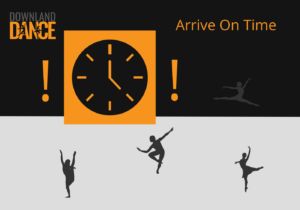
- Arrive on time. Barre or warm-up exercises are designed to warm up the body slowly and safely. A student who misses the initial exercises – e.g. pliés and tendus – risks injury by joining the class work when more strenuous exercises are being performed.
- It is important to inform your teacher of any injuries you have at the start of the class, even if they are minor. If you cannot perform a step because of an injury your teacher doesn’t know about, they may think you’re slacking!
- If you need to enter a studio whilst a class is ongoing, do so as quickly and discreetly as possible. Avoid entering in the middle of an exercise or whilst the music is playing.
- If you’re arriving late to a class, find an easily accessible place to warm up or participate.
- If you’ve been invited to watch a class, make sure you remove your outdoor shoes before entering the studio.
- Eating or chewing gum in the studio is forbidden.
- A good ballet or dance class has a quietly courteous atmosphere. It’s a time to concentrate on the teacher and on your own body to improve skills. In class give complete attention to your instructor and keep talking, gossiping and giggling to a minimum as it can be interpreted as disrespectful, and disturb or intimidate your fellow dancers. Let your movements do the talking and make the message beautiful!
- Hold your placement throughout the class. Teachers design classes to help your body warm up and align in a particular sequence. Slumping between exercises will undo much of the progress you make during class time.
- Pay attention to your teacher, even if they aren’t talking to you. Corrections others get can also be useful for you.
- Don’t look at the clock. When you look at the clock, you’re communicating to the teacher that you’re tired of class and ready for it to be over. Even if that isn’t how you are feeling, that’s how it translates. Stay engaged the whole class.
- Body language is extremely important in any dance class. Dance teachers are constantly ‘reading’ students bodies in order to give them specific instruction. If you are standing with your arms crossed, slumping, leaning against the barre and/or sitting, the teacher will think you are bored or uninterested.
- Take corrections with a positive mindset. Individual corrections are positive attention from your teacher and are an important part of learning.
- Pay attention when your classmates are dancing. You can learn from each other.
- Applaud for demonstrators and encourage others in class. If you see someone do something brilliant in class, tell them! If you love your teacher’s choreography, express that! Class should be a positive space filled with vibrant energy. Communicate the moments that you’re genuinely inspired by others. You’ll make everyone’s day brighter, and that positivity will come back around to you.
- Work on your sense of spacial awareness and demonstrate it. You’ll thank us later!
- In the centre or across-the-floor work, when a combination is over, it is proper to run forward, first, and to the side, second, as fast as possible to allow the next group of dancers to run into place. This will help you avoid collisions and keep the class flowing.
- If you need to leave early, talk to your teacher before the class, and make your exit as quick and discreet as possible.
- Avoid walking between the teacher and the rest of the class. If you need to cross the room, you must walk around the back.
- I CAN´T is not in your vocabulary. Attending class and learning exercises is the main reason for attending dance. It is not supposed to be easy. Classes and instructions are intended to challenge you. It is okay to mess up. It is not okay to give up.
- You can acknowledge the teacher following reverence by applauding as a group before your departure from the classroom. Clapping after class is a show of respect for the guidance of the teacher.
- If you are watching a class, it is polite to stand during the reverence as a show of respect for the hard work of the students and teacher.